
What do we really know about the Korean language? Those who have interacted with native speakers might agree that it seems like a challenging language. It gives the impression of being difficult, with an unfamiliar, hieroglyph-like alphabet that seems hard to memorize and decipher. And if one has made a hobby of watching Korean TV series, we may catch crumbles of common words or phrases here and there, but it still feels complex, doesn’t it?
An Isolated Language
Korean is considered an isolated language, meaning it doesn’t belong to any established language family. There are varying opinions on where it fits linguistically; some experts classify it as an Altaic language, suggesting it might share commonalities with languages like Turkish or Mongolian.
Though it is somewhat related to Japanese in terms of structure, Korean stands alone. Globally, around 78 million people speak Korean, including speakers outside of North and South Korea, particularly in the Chinese province of Yanbian.
The dialects spoken in North and South Korea have only minor differences. The main exception is the Jeju Island dialect, which some linguists argue is a language in its own right.
Korean Writing System
Initially, Korean writing utilized Chinese characters known as hanja. However, the significant linguistic differences between Korean and Chinese led to the gradual creation of specific characters to transcribe Korean sounds. This development culminated in the creation of the Korean writing system, hangul, in the 15th century, during the reign of King Sejong, the fourth monarch of the Joseon Dynasty.
Today, about half of the Korean vocabulary consists of native Korean words written in hangul, while the other half includes Sino-Korean terms borrowed from Chinese, transcribed with Chinese characters. In everyday communication, native Korean words are used more frequently, while Sino-Korean words are preferred in formal or official contexts. Korean has also borrowed some terms from Mongolian, Sanskrit, and in modern times, English.
Unlike Japanese or Chinese, Korean uses spaces between words. Historically, characters were written in vertical columns from right to left, but today the writing follows a horizontal, left-to-right structure, except in traditional calligraphy.
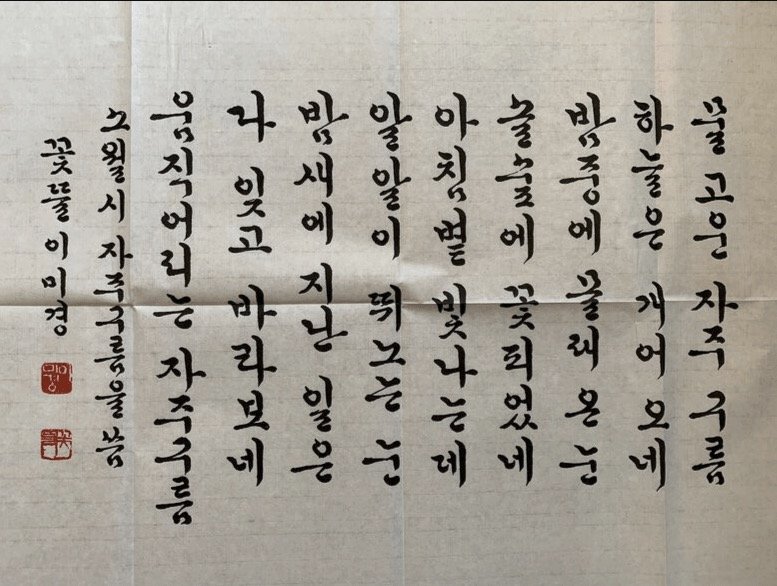
The hangul alphabet is syllabic, with each syllable serving as the basic unit. Letters combine within a syllable, and the first position is always occupied by a consonant, followed by a vowel. If a syllable starts with a vowel, a special character is placed in front, though it remains silent in this position.
Korean Grammar
Korean is an agglutinative language, which means it uses a wide variety of prefixes and suffixes attached to word roots rather than relying on prepositions or conjunctions. The word order in a sentence is typically subject – object – verb (SOV), unlike the subject – verb – object (SVO) structure in English. Nouns in Korean don’t have gender and do not decline.
One of the most intricate aspects of the language is its politeness system, which has multiple levels, each requiring different verb endings and forms.
The Spread of Korean Language Worldwide
The growing popularity of Korean pop culture, known as hallyu or the Korean Wave, has significantly contributed to the global spread of the Korean language. A key role in providing worldwide access to quality language learning is played by the King Sejong Institute, which operates 256 branches in 88 countries.
Final Thoughts
As a Korean learner, the one thing I want to convey is to give it a chance. Korean is not as difficult as it might seem at first. If you commit to learning it, remember that consistency and time are essential. With dedication, you will be able to speak Korean fluently and appreciate the rich culture that it embodies.
Sources: korea.net, World Voiceovers, Pexels, The Kraze




 The Fellow's Table
Leave a comment