
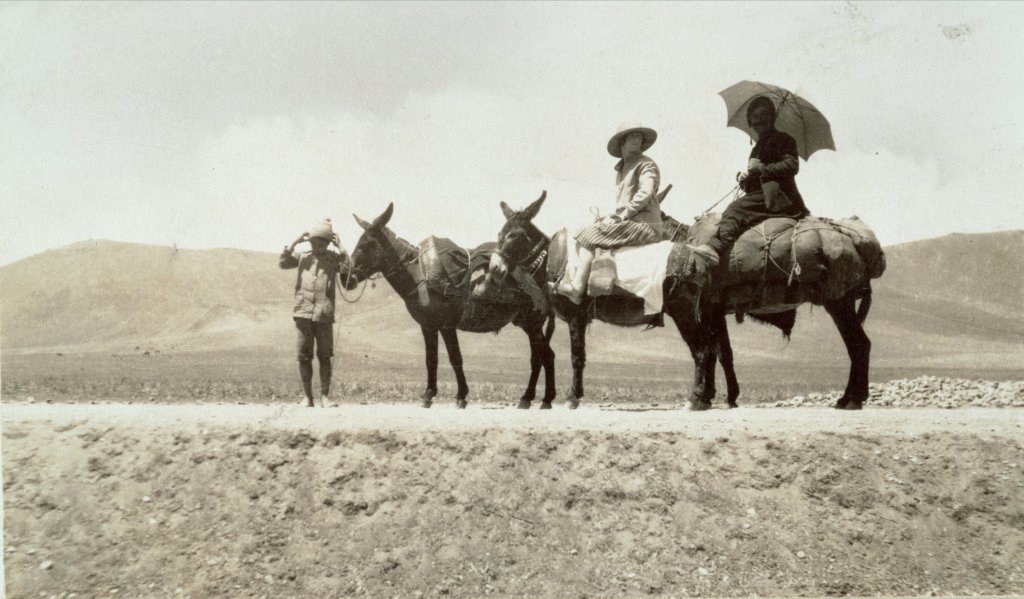
Books provide an endless source of fascination about the world. One can never get tired of ‘time traveling’ by reading novels whose plots are centuries behind our backs.
Such was my experience last summer when I read Letters from Syria, a splendid collection of letters written by Freya Stark during her travels through Syria in the 1920s.
Before the discovery of natural resources in the region, Westerners manifested a more or less sincere curiosity about anything that, in their minds, depicted and portrayed “The East.” This interest later became known as “Orientalism,” a concept that many scholars associate with the imperialist societies that produced it.
Still, few ventured to live the “oriental” tales they heard, and even fewer were women. Among them were the renowned Gertrude Bell and Freya Stark (we will dedicate a separate article to Bell). Both learned Arabic to be able to interact directly with locals. It is through their travel journals and letters that we gain an unaltered glimpse of daily life in lands where humanity thrived on generosity and wisdom.
Freya Stark’s journey to Syria began in 1927, when she set out from Venice on a small cargo vessel to Rhodes, eventually continuing to Beirut. She spent three cold winter months in Broummana, a Syrian village on the slopes of Lebanon, high above Beirut. One of her daily tasks during this time was to master Arabic.
“Broummana is a glorious village, a long ridge of neat stone houses with red hillside of pines drooping straight to Beirut and the sea, and Lebanon, a stony mass with narrow slits for valleys, rising very evenly to its snowy watershed on the south,” Stark writes.
In her letters from Lebanon, Stark also mentions the region’s intricate cultural melting-pot, marked by ongoing conflict: “This Christian country is divided into fierce and venomous little sects. The Druses are dignified and keep whatever their religion may be very properly to themselves, ready to massacre the Others if the opportunity should come, but otherwise polite.”
When her stay in Broummana ended, Stark moved on to Damascus. She admired the city’s “brilliant sky and green gardens” and described its old streets as “scented with jasmine.” Elsewhere, she marvels at “the oasis of orchards, domes, and minarets” contrasting with the surrounding desert.
As Stark traveled deeper into the region, she reflected on its cultural values. Unlike the individualism she was accustomed to in the West, she observed a strong sense of group cohesion in Lebanon and Syria.
“What I find trying in a country which you do not understand and where you cannot speak, is that you can never be yourself. You are English, or Christian, or Protestant, or anything but your individual you: and whatever you say or do is fitted to the label and burdened with whatever misdeeds (or good deeds) your predecessors may have committed.”
Letters from Syria is available digitally on the Open Library, where you can read it for free.
Image credits: Daily Sabah,



 The Fellow's Table
Leave a comment