
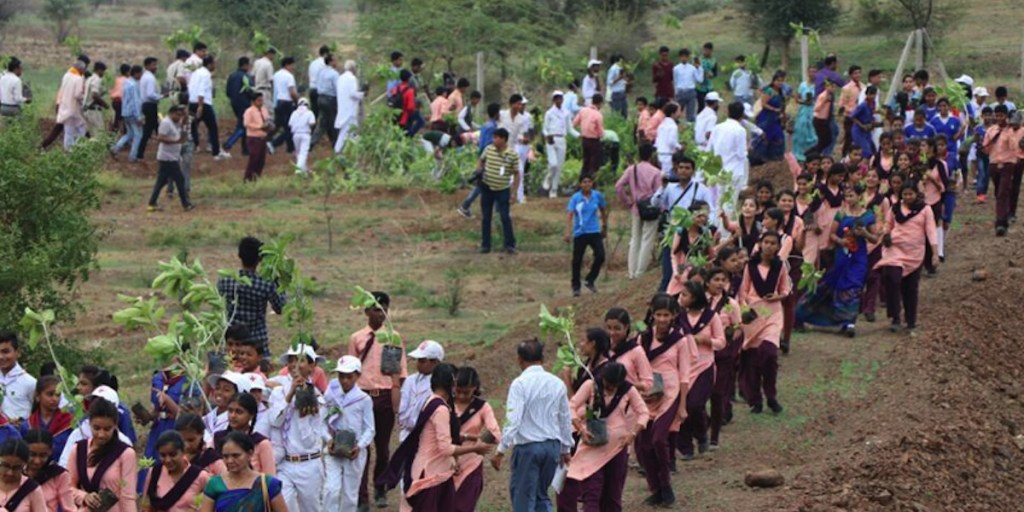
Madhya Pradesh volunteers lead massive tree-planting effort along sacred river
India has once again made history in its fight against climate change by setting a new Guinness World Record. In an extraordinary environmental effort, 1.5 million volunteers planted over 66 million tree saplings in just 12 hours in the state of Madhya Pradesh.
This record-breaking achievement took place on July 2, with volunteers working tirelessly from 7:00 AM to 7:00 PM along the Narmada river, one of India’s seven sacred rivers. Over the past decade, environmentalists have raised concerns about the river’s pollution, over-extraction of water for irrigation, and industrial waste.
The record, previously held by the state of Uttar Pradesh, has evolved into an unprecedented social action aimed at raising awareness of India’s climate change initiatives, known as the “make India green again” plan.
India’s environmental indicators are declining, Yale’s EPI reveals
The mass planting on Sunday had a significant meaning for India’s environmental commitments, as the country is regularly ranked among the lowest in air quality, projected emissions, and biodiversity and habitat, according to Yale’s Environmental Performance Index (EPI).
India accounts for 7.33 percent of the global greenhouse gas emissions and is the third-largest emitter after China and the United States, the Emissions Database for Global Atmospheric Research (EDGAR) reports.
While trees have a critical role in combating climate change, India is aiming for 29 percent forest cover by 2030
Currently, roughly 22 percent of India’s geographical area is covered by forests, according to the India State of Forest Report. The country is committed to regrowing its forests and aims to increase total forest cover to 29 percent by 2030 to combat climate change.
Forests, often called the lungs of the planet, are known to mitigate the greenhouse effects by absorbing carbon dioxide. On average, a tree absorbs 25 kg of CO2 per year, while forest strips create riparian buffer zones that prevent erosion, preserve ecosystems, and cool down the hot air in cities.
Among India’s environmental initiatives registered in the Guinness Book of Records are the most plastic recycled in 2015 and the largest tree hug in 2017.
Image credits: ecowatch.com






 The Fellow's Table
Leave a comment