
One year ago, during a summer holiday in picturesque Brașov, Romania, I stumbled upon Next Stop Execution, Oleg Gordievsky’s gripping autobiography. As an avid reader, I value bookstores where you can lose yourself among the shelves. This was precisely my experience when my eyes fell upon the memoir of one of the most consequential spies of the Cold War.
Coming from a country where espionage activities are bread and butter, I felt compelled to read this book, especially as recent events in Europe have revived memories of Cold War espionage.
A high-ranking KGB officer, Gordievsky began secretly collaborating with MI6 in 1974, while stationed in Copenhagen, Denmark. For more than a decade, he funneled Soviet secrets over to the British, until the Soviets uncovered his activities.
Summoned back to Moscow, he faced interrogation and house arrest. In a daring and meticulously planned escape, MI6 smuggled him out of the Soviet Union, hidden in the trunk of a car crossing the Finnish border.
In his memoir, Gordievsky recounts growing up in a family deeply loyal to Soviet ideals, with both his father and sibling working for Soviet intelligence. After graduating from high school in 1956, he enrolled at the prestigious Institute of International Relations.
As a young student, Gordievsky witnessed significant events shaping the Soviet Union and the Communist Party’s direction:
“I liked the institute from the very first day: everything suited me, especially as the place was brimming with anti-Stalinist enthusiasm following Khrushchev’s secret speech at the 20th Congress of the CPSU in March. Even six months later, it continued to provoke strong reactions.”
He recounts being recruited by the KGB during his time at the institute:
“In Moscow, I noticed that two members of the KGB spent a lot of time in the institute building: they had a small office and generally kept a low profile (…). For a long time, I wasn’t entirely sure what they were doing, but gradually I realized they were scouting potential recruits—and that the man representing the First Chief Directorate had his sights set on me.”
Rather apologetically, Oleg Gordievsky explains the allure of a KGB career for him and many of his friends:
“I was drawn to the idea of a career in the KGB, partly because it would follow in my father’s footsteps, but also because it offered the chance to work and live abroad—one of the main ambitions of nearly every student at the institute. We all knew the Soviet Union resembled a prison, and the only way to escape, even temporarily, was to join one of the organizations that operated in other countries: the Ministry of Foreign Affairs, press agencies like TASS and APN, or the KGB. (…) Beyond that, the organization held a certain allure for us: the secrecy, the trappings of espionage, the specialized skills and methods. And we didn’t overlook the financial aspect—the KGB’s salary was slightly higher than in other fields.”
After completing his training, Gordievsky was assigned to the Soviet Embassy in Copenhagen, Denmark. He vividly recalls his first impressions of life outside the Soviet Union:
“I arrived in Copenhagen on a bright, frosty winter day in early January 1966. I was immediately struck by the beauty of the city, its cleanliness, and prosperity. Coming from the austerity of the Soviet Union, I now found myself discovering a new world, a wonderland of elegant buildings, luxury cars, and shops brimming with goods.”
Working for the KGB, Gordievsky quickly grew disillusioned with the Soviet regime. By 1974, he began sharing critical intelligence with MI6. He also describes the oppressive stagnation of the USSR under Brezhnev:
“The optimism of the early 1960s during Khrushchev’s time had vanished; back then, there had been at least a sense that, while still communist, society was making progress. By the 1970s, under Brezhnev, even the semblance of stagnation was gone—there was only regression.”
“The Soviet imperialist tendencies were becoming increasingly aggressive across Africa—in Mozambique, Angola, Ethiopia, and Algeria—and more hostile toward China, with an exaggerated and almost hysterical focus on the so-called Chinese threat. Domestically, the KGB apparatus had grown grotesquely large: the First Chief Directorate alone had expanded from nearly 5,000 to 16,000 employees.”
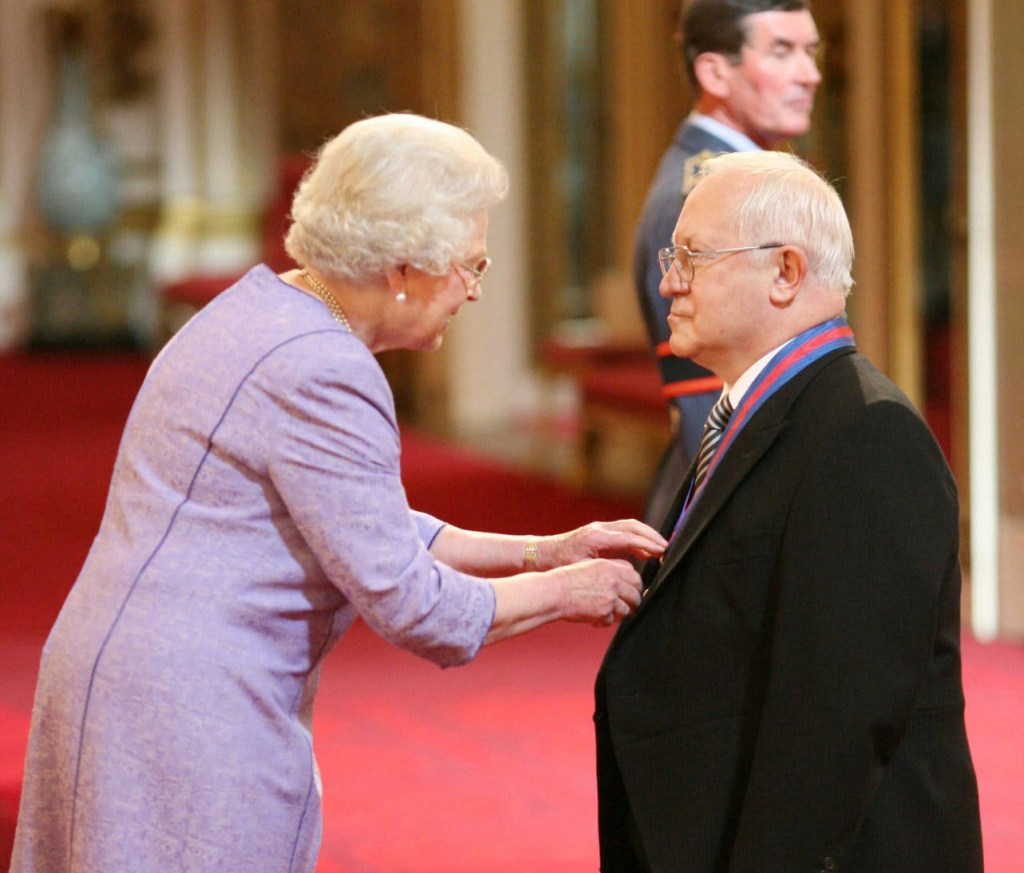
After his escape to the West, Gordievsky was granted asylum in the UK, where he lived under tight security. For his services, Queen Elizabeth II awarded him the Order of St. Michael and St. George. Reflecting on his life in exile, he writes:
“As for my future, it seems I will remain in the West. As I write this [1994], I am still under a death sentence in Russia (…). Over time, I find myself increasingly rooted in England, and the likelihood of returning to Russia diminishes with each passing year.”
Life abroad, however, didn’t guarantee safety. As the past has shown, Russian intelligence rarely forgives betrayal. In 2008, Gordievsky alleged he was poisoned at his Surrey home in a failed assassination attempt. He fell unconscious for 34 hours and spent two weeks recovering in a private clinic.
In an interview with the Mail, he remarked, “I’ve known for some time that I am on the assassination list drawn up by rogue elements in Moscow.” He believed his poisoning was part of revenge attacks by the same Russian intelligence agents who murdered Alexander Litvinenko in London in 2006.
Photo credits: The New York Times




 The Fellow's Table
Leave a comment