
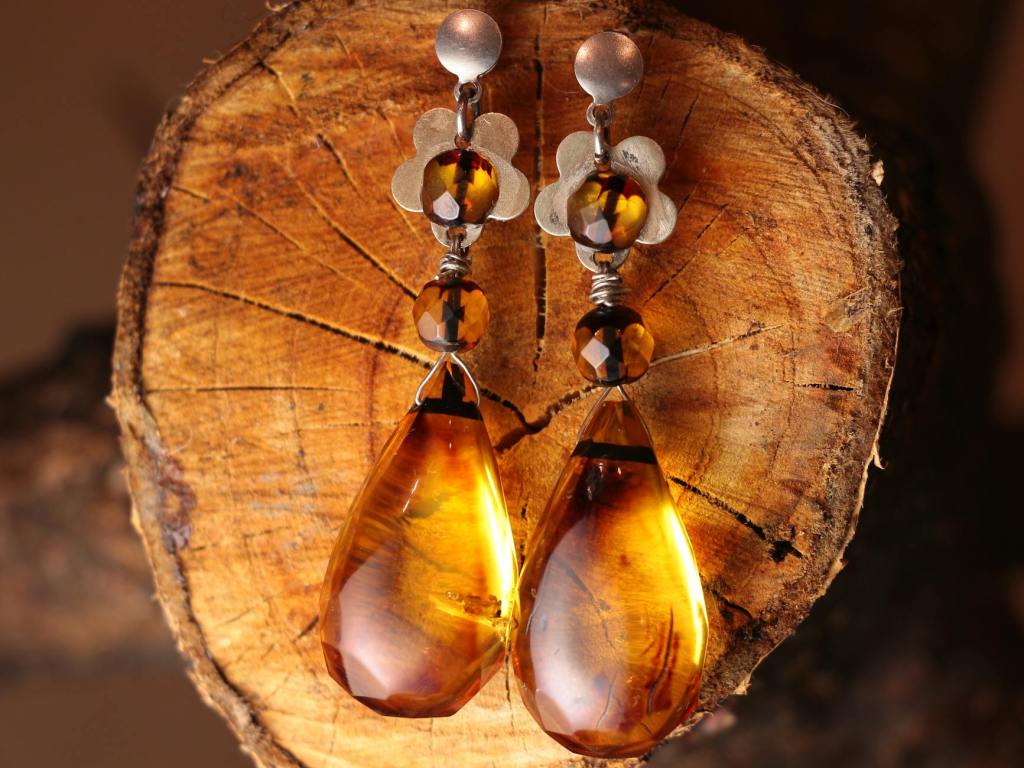
Before leaving Lithuania, we went to Vilnius Old Town for the last time. Its beautiful historical buildings, arranged along intertwined streets, won our hearts forever. It was then that my husband and I made an arbitrary decision to enter an amber shop we discovered, hidden under the dim streetlight.
Although not big fans of jewelry—mainly because its price doesn’t appeal to those with empty pockets—we were quite fascinated by the craftsmanship of amber, which was new to us. Soon, we became acquainted with what the Baltics call “The Gold of the North.”
Widely available and easy to carve, amber has been used by artisans for jewelry and ornaments for more than 10,000 years. It is very lightweight, with a density comparable to seawater, making it comfortable to wear.
Amber is a semi-precious gemstone and one of the few organic gemstones. In fact, it is the preserved resin of ancient pine trees that existed millions of years ago. During the transformation process undergone by tree resin, over forty compounds—including succinic acid, potassium, sodium, and iron—contributed to the formation of amber in the form we know today. Amber is well known for containing inclusions of ancient insects and plant species, which have been preserved within it.
The age of amber varies between 30 and 100 million years, with the oldest known being Burmese amber. On the other hand, Baltic amber—the type my partner and I saw in that shop—is between 30 and 50 million years old. A few other places on Earth contain amber deposits, varying in age, color, and properties.
The simplest way to classify amber is by its color. While yellow amber is the most common variety, making up around 70 percent of all amber on Earth, other colors—such as black, green, white, and even blue—can also be found. Blue amber, with its captivating blue fluorescence, is found in a few locations around the world, including the Dominican Republic, Mexico, Myanmar, and Indonesia. This is by far the rarest type of amber, making up just 0.2 percent of the world’s supply.
The most expensive amber artwork ever created is the Queen’s Amber Room, estimated to be worth $150 million. Initially designed for the King of Prussia, Frederick I, in the 18th century, this priceless masterpiece was looted by the Nazis during World War II and has not been found to this day.
However, not everyone is aware of amber’s value. Take the example of an elderly woman in Romania who used an amber nugget as a doorstep for decades. Her relatives later discovered that the stone was probably one of the largest amber pieces in the world, valued at over $1 million.
Image credits: No Edited Pics


 The Fellow's Table
Leave a comment